
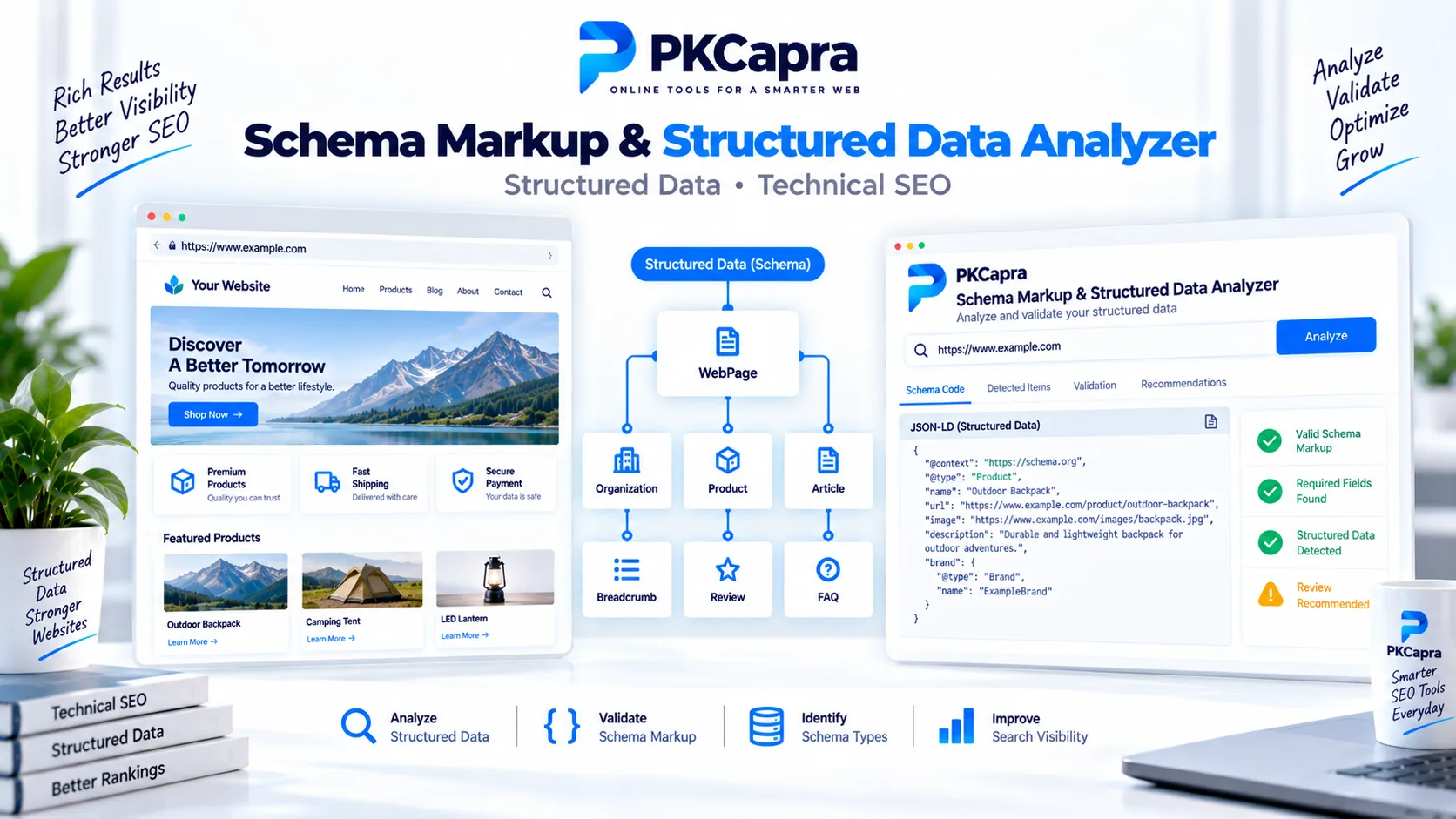
Schema Markup & Structured Data Analyzer helps you review schema markup and structured data found on a webpage. With this tool, you can examine structured data information and identify areas that may need further investigation as part of your technical SEO review.
PKCapra Schema Markup Analyzer
Deeply inspect JSON-LD, Microdata and RDFa, map schema entities and relationships, detect consistency risks, and separate Schema.org diagnostics from Google-specific eligibility.
Public HTML only. No CMS login required.Check Schema Markup and Structured Data
Structured data provides search engines with additional information about the content of a webpage. Therefore, correctly implemented structured data can help search engines better understand what a page represents.
However, adding structured data does not guarantee that Google will display a rich result. For this reason, website owners should focus on accurate, relevant, and complete markup rather than adding unnecessary structured data.
What Does a Schema Markup & Structured Data Analyzer Check?
A Schema Markup & Structured Data Analyzer helps you review structured data associated with a webpage. As a result, you can get a clearer view of the markup that search engines may encounter.
In addition, reviewing structured data can help you investigate potential implementation issues. For example, you can use the analysis as an initial step before validating your markup with dedicated structured-data testing tools.
Why Is Structured Data Important for SEO?
Structured data gives search engines explicit information about the meaning and type of content on a page. For example, websites can use supported structured-data formats to provide information that Google can use for certain search features.
At the same time, structured data does not automatically improve rankings or guarantee a special search appearance. Therefore, you should treat structured data as one part of a broader SEO strategy rather than a standalone ranking solution.
How to Use the Schema Markup & Structured Data Analyzer
First, open the Schema Markup & Structured Data Analyzer on PKCapra. Next, provide the webpage information requested by the tool. Then, start the analysis and review the available structured-data information.
Afterward, investigate any areas that may require additional attention. Finally, validate important markup with an appropriate structured-data testing tool before making it part of your production website workflow.
Schema Markup and Rich Results
Structured data can make pages eligible for certain enhanced search appearances when they meet Google’s requirements. However, eligibility does not guarantee that Google will display a rich result for every page.
Therefore, use structured data to describe content accurately and follow the requirements for the specific structured-data feature you want to support. In addition, Google recommends testing structured data during development and monitoring it after deployment.
When Should You Check Structured Data?
You can review structured data during regular technical SEO audits. For example, checking schema markup can be useful after a website redesign, template change, content update, or implementation of new structured-data types.
Similarly, review important pages after making changes to their markup. This way, you can investigate unexpected changes before they affect a larger part of your website.
Furthermore, Google recommends using validation tools and checking deployed pages to make sure structured data remains accessible and valid.
Technical SEO Tools from PKCapra
Explore More Technical SEO Tools
Structured data is only one part of a technical SEO review. For example, you can use the Meta Tags Analyzer to review important page metadata.
Similarly, the Robots.txt Analyzer can help you examine robots.txt directives. In addition, the XML Sitemap Analyzer can help you review sitemap-related information.
Furthermore, the Indexability & Crawlability Analyzer can help you investigate technical signals related to search-engine access and indexing.
For a broader collection of confirmed PKCapra tools, visit the All Free Online Tools directory.
Tips for Reviewing Schema Markup
Tips for Better Structured Data
First, make sure your structured data accurately represents visible page content. Next, use the structured-data type and properties that actually apply to your page.
Also, avoid adding irrelevant or misleading markup. Google specifically requires structured data to represent the content on the page and warns against misleading or unrelated structured data.
Afterward, validate your implementation with the appropriate testing tools. Finally, monitor important pages after deployment because changes to templates or how markup is served can introduce new issues.
Frequently Asked Questions
What is a Schema Markup & Structured Data Analyzer?
A Schema Markup & Structured Data Analyzer is an SEO tool that helps you review schema markup and structured data associated with a webpage.
What is schema markup?
Schema markup is structured information that describes webpage content in a standardized format. Therefore, it can provide search engines with additional context about the content of a page.
Does structured data guarantee rich results?
No. Although valid structured data can make a page eligible for certain rich-result features, Google does not guarantee that those features will appear in search results.
Why should I check my structured data?
Checking structured data can help you identify implementation issues and confirm that your markup represents the page content accurately.
Which format does Google recommend for structured data?
Google supports JSON-LD, Microdata, and RDFa. However, Google generally recommends JSON-LD because it is usually easier to implement and maintain.
How can I validate schema markup?
First, you can review the markup with a suitable analyzer. Then, use Google’s Rich Results Test for Google-specific rich-result eligibility and the Schema Markup Validator for broader Schema.org validation.
Analyze Your Schema Markup
Ready to review your structured data? Use the Schema Markup & Structured Data Analyzer from PKCapra to examine schema markup on your webpage and identify areas that may need further investigation.
Helpful Structured Data Resources
Use Google Search Central as the primary external resource:
For official guidance, you can also review Google’s documentation about structured data and learn how Google uses structured data to understand webpages and support eligible search features.